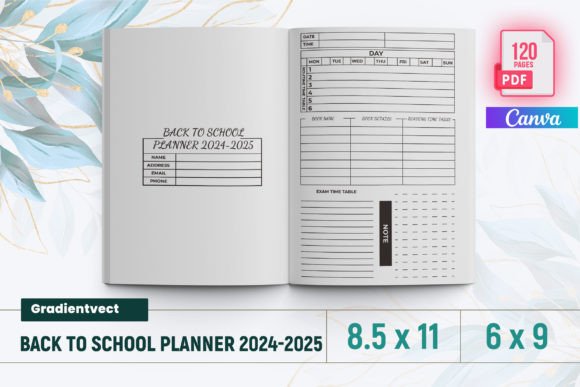
Back to School Planner 2024-2025 Canva
Whether you’re a parent organizing your child’s first year of middle school, a teacher streamlining lesson prep and parent meetings, or an indie publisher building a niche KDP product line—this Back to School Planner 2024–2025 Canva template is built for real-world use. It’s not just another printable—it’s a fully editable, bleed-ready interior file designed from the ground up for clarity, consistency, and creative flexibility.
What makes it stand out? Every page serves a purpose—not decoration. The 120-page structure balances practicality with intentionality: daily review prompts sit beside subject lists; weekly planners include space for extracurricular sign-ups; and the “My Daily Chore Tracker” integrates seamlessly with “My Daily Routine Tracker.” There’s no filler. Just thoughtful scaffolding for students, families, educators, and creators alike.
Why This Planner Fits Real Life—Not Just Ideals
School years don’t follow perfect rhythms. Schedules shift. Priorities evolve. A planner that assumes static routines quickly becomes obsolete. That’s why this Back to School Planner 2024-2025 Canva includes responsive sections like “Reminders before bed” and “Reminders after bed”—small but critical anchors for habit-building. It also features dual-purpose pages: the “Annual Overview” supports long-term goal-setting, while the “Monthly Review” encourages reflection without overwhelm.
The inclusion of both a 2024–2025 monthly calendar and a 2024–2025 calendar grid gives users options—visual planners can map deadlines across months; linear thinkers can track progress week by week. Even the “Vision Board” page avoids vague prompts: it guides users to list three measurable goals, two skills to practice, and one environment change they’ll make—keeping aspiration grounded in action.
Creative Adaptations for Different Users
This isn’t a one-size-fits-all tool—it’s a springboard. Here’s how different audiences are already using it:
- Educators duplicate the “School Timetable” and “Exam Timetable” pages into editable slide decks for student orientation. They replace generic headers with school-specific language (“Block Schedule A” vs. “Period 1”) and embed QR codes linking to digital resources.
- KDP publishers use the provided PNG and JPG files to mock up lifestyle covers—realistic desk shots with open planners, coffee mugs, and highlighters—then pair them with targeted Amazon backend keywords like “editable back to school planner KDP interior” and “Canva school planner 2024 PDF.”
- Freelance designers import the Canva file, swap fonts and color palettes to match brand guidelines, and re-export as custom-branded versions for school PTA groups or tutoring centers.
- Parents print only the pages they need—like “Supplies List,” “Book List,” and “Important Dates”—and bind them into a slim, laminated reference booklet for back-to-school shopping trips.
No redesign required. Just edit, export, and deploy.
Designed for Platform Precision—Especially KDP
If you’ve uploaded interiors to Kindle Direct Publishing before, you know how easily formatting slips: margins cut off text, bleed lines misalign, or PDF compression flattens layers. This Back to School Planner 2024-2025 Canva solves those issues upfront. All files were tested on KDP using their latest specs—including 6″ × 9″, 8.5″ × 11″, and other common trim sizes—and confirmed to pass auto-checks. The bleed is built-in, not added as an afterthought.
That means less time troubleshooting, more time iterating. You can confidently upload the ready-to-go PDF—or tweak individual pages in Canva, then re-export with embedded fonts and flattened transparency (no hidden layers to trip up KDP’s processor).
How to Keep Your Use Clear, Consistent & Audience-Friendly
Clarity starts with restraint. When customizing this planner, avoid overloading pages with extra graphics or dense fonts—even in Canva, readability trumps flair. Stick to one primary font family (the template uses clean, accessible sans-serifs), limit color accents to two or three, and always preview at 100% zoom before exporting.
Consistency comes from structure—not style. Use the existing layout logic: left-aligned headers, uniform spacing between sections, and intentional white space around checklists. If you add new pages (e.g., “Teacher Feedback Log”), mirror the same heading hierarchy and margin rules so users intuitively know where to look.
Audience-friendliness means anticipating context. A student using the “Study Tracker” needs quick-glance icons and minimal text. A homeschooling parent using the “Extra-mural Timetable” benefits from clear time-blocking zones and space for contact info. Edit with those needs in mind—not just aesthetics.
Ideas That Go Beyond Printing
This planner doesn’t have to live only on paper. Try these low-lift, high-impact extensions:
- Digital habit stacking: Use the “My Daily Checklist” as a Notion template—turn each bullet into a toggleable task, link to calendar events, and set recurring reminders.
- Classroom wall display: Print select pages—“Important Dates,” “Yearly Goals,” “Vision Board”—at poster size and hang them in learning spaces to reinforce shared priorities.
- Parent-coach collaboration: Share editable Canva links with tutors or academic coaches. They update the “Reading List” or “Study Tracker” in real time; parents see changes instantly.
- Student-led conferences: Have learners fill out the “Monthly Review” and “Daily Review” pages ahead of meetings—then use them as conversation starters about growth, challenges, and next steps.
None require coding or complex tools. Just intention, access to Canva, and attention to who’s using the page—and why.
Final Thought: Tools Shape Habits
A planner isn’t just about tracking time—it’s about shaping attention, reinforcing values, and making invisible work visible. The Back to School Planner 2024-2025 Canva does that by giving structure without rigidity, flexibility without chaos, and inspiration without abstraction. Whether you’re publishing your fifth KDP journal or helping your child navigate their first semester of high school, it meets you where you are—and supports where you’re going.