Back to School Numbers Pack: A Practical Resource for Early Number Skills
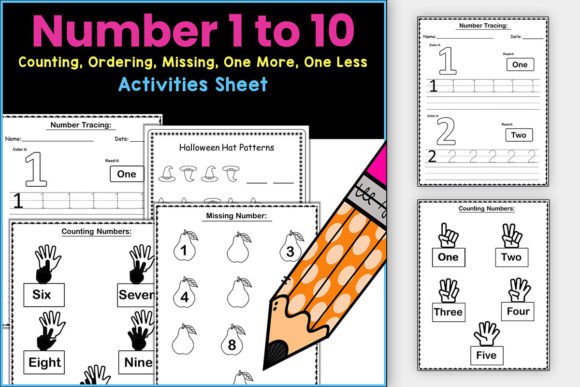
The Back to School Numbers Pack is a targeted, printable worksheet collection designed specifically for early learners—typically preschool through first grade—who are building foundational number sense. Unlike broad math curricula or digital apps with shifting interfaces, this resource focuses tightly on five core competencies: number tracing, quantity-number matching, object counting, number ordering, and identifying missing numbers within sequences from 0 to 10. Its consistency, thematic cohesion, and built-in scaffolding (like embedded number lines) make it a practical tool—not just for August, but across the full school year.
What Sets This Pack Apart From General Math Printables
Many early math worksheets prioritize either skill variety or visual appeal—but rarely both without sacrificing clarity. The Back to School Numbers Pack avoids that tradeoff by anchoring all activities in a single, relatable context: the back-to-school transition. A pencil, an apple, a backpack, or lined notebook paper appear subtly across pages—not as distractions, but as familiar reference points that support engagement without diluting mathematical intent.
Each of its 18 pages serves a defined purpose: five dedicated to number tracing (emphasizing grip and stroke direction), two each for matching, counting, ordering, and missing numbers. That intentional distribution reflects developmental sequencing—tracing supports motor control before independent writing; matching builds symbolic understanding before abstract sequencing. Crucially, every worksheet includes a number line from 0 to 10. This isn’t decorative—it’s functional scaffolding, visible on every page, reducing cognitive load when students compare values or spot gaps.
How It Compares With Other Early Learning Formats
Compared to digital learning tools, the Back to School Numbers Pack offers immediacy and tactile reinforcement. There’s no login, no device dependency, no screen time management. Students hold a pencil, feel resistance on paper, and develop fine motor coordination alongside number recognition—a dual benefit many screen-based alternatives can’t replicate.
Yet it’s not a replacement for interactive instruction. Where manipulatives like counters or ten-frames allow kinesthetic exploration, or whiteboard-based whole-group practice invites discussion and error analysis, this pack excels in independent, low-stakes repetition. It fits cleanly into math centers, morning work routines, or take-home practice—situations where consistent, self-directed reinforcement matters more than real-time feedback.
Compared to open-ended activity books or generic “number practice” PDFs, the Back to School Numbers Pack stands out for scope and restraint. It doesn’t try to cover addition, place value, or measurement. It stays within 0–10, honoring the reality that mastery at this range underpins later fluency. Some broader resources scatter attention across too many concepts; this one deepens focus where it counts most for emerging learners.
Strengths and Realistic Tradeoffs
Strengths:
- Print-ready quality: At 8.5 × 11 inches and PDF format, it prints consistently across home and school printers—no resizing, cropping, or formatting surprises.
- Visual consistency: The number line appears identically on every page, helping students internalize its structure rather than relearn layout with each new worksheet.
- Low-prep utility: No cutting, laminating, or prep required. Teachers or caregivers can assign pages directly—or use them flexibly across small groups, interventions, or mixed-ability stations.
- Developmentally calibrated: Tracing pages isolate formation; matching pages pair concrete images (e.g., three apples) with numerals; missing-number tasks use short, predictable sequences (e.g., 4, __, 6)—all aligned with typical K–1 progression.
Tradeoffs to Consider:
- No differentiation built-in: While adaptable (e.g., a teacher might ask advanced students to extend a sequence beyond 10), the pack itself doesn’t include tiered versions. Educators supporting diverse needs may need to supplement with extension prompts or scaffolded supports.
- Limited language integration: It focuses squarely on numeracy—not vocabulary, sentence framing, or oral explanation. For classrooms emphasizing math talk or ELL support, pairing it with guided discussion or sentence stems would be necessary.
- Static format: As a PDF, it doesn’t adapt to student responses or offer immediate correction. It’s best used alongside formative checks—not as a standalone assessment tool.
When the Back to School Numbers Pack Fits—and When It Doesn’t
This resource shines in structured, repeatable contexts: a kindergarten morning tub where students rotate through quiet tasks; a first-grade intervention block reinforcing number order before tackling teen numbers; or a homeschool routine where consistency and clear objectives reduce daily planning load. It’s especially helpful for students who benefit from visual anchors (the number line), predictable layouts, and incremental challenges—such as those developing executive function or fine motor control.
It’s less suited for settings requiring rapid progress monitoring, collaborative problem solving, or multi-sensory input. If your goal is to assess conceptual flexibility (e.g., “Show me 7 in three different ways”), explore part-whole relationships, or connect numbers to real-world data (e.g., class surveys), you’ll need complementary tools—like dot cards, number bonds mats, or simple graphs.
Similarly, for students significantly below grade-level expectations—say, still struggling with one-to-one correspondence beyond 5—the tracing and matching pages remain accessible, but the ordering and missing-number tasks may require significant pre-teaching or adaptation. In those cases, using just the first few pages intentionally, paired with hands-on modeling, often yields better results than assigning the full sequence.
Practical Integration Tips
Because the Back to School Numbers Pack is modular, it adapts easily to different pacing and goals:
- Start with tracing + matching: Build numeral recognition and motor memory before asking students to generate numbers independently.
- Use counting pages to bridge to word problems: After completing “Count the crayons and write the number,” ask, “What if 2 crayons break? How many are left?”—adding verbal reasoning without changing the worksheet.
- Turn ordering into a partner game: Cut apart number tiles from the ordering pages, mix them up, and have students race to sequence them—then check against the number line on their worksheet.
- Repurpose missing-number pages for pattern talk: Instead of just filling blanks, ask, “How do you know what goes there? What’s the same about these numbers?”
In summary, the Back to School Numbers Pack isn’t a curriculum—but it is a well-designed, focused instrument. Its value lies not in novelty or breadth, but in reliability, alignment, and quiet intentionality. For educators and caregivers seeking straightforward, printable reinforcement of essential early number skills—without distraction, complexity, or setup overhead—it earns its place among practical, classroom-tested tools. And because it works equally well in September or March, its usefulness extends far beyond the first week of school.